International advocacy
DPA has a long history of engaging and advocating internationally for disabled peoples rights.
Our recent international work
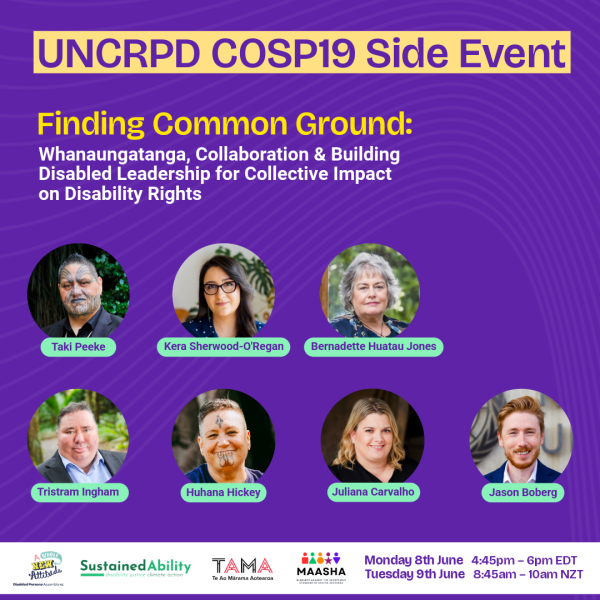
This year, DPA is the primary sponsor for Finding Common Ground – a UNCRPD COSP 19 Side Event.
Finding Common Ground: Whanaungatanga, collaboration, and building disabled leadership for collective impact on disability rights
We are proud to be co-sponsors with Te Ao Mārama Aotearoa (TAMA), SustainedAbility Disability and Climate Network, Migrants Against the Acceptable Standard of Health Aotearoa (MAASHA)
About the event
In this session, we will hear from disabled leaders who are championing collaborative, cross-sector, cross-community leadership and advocacy initiatives that are shaping disability rights movements and translating the UNCRPD into practice — from Aotearoa New Zealand to the global arena.
- When: Tuesday 9 June 2026, 8:45am to 10:00am NZT
- Location: Online via Zoom
- Cost: Free
- Registration: Register online
There will be a focus on Aotearoa New Zealand initiatives like Finding Common Ground, grassroots organising through MAASHA, and efforts to strengthen disability representation within international climate governance, to demonstrate how disabled people are using the CRPD and its periodic review process as tools for accountability, advocacy, and collective action.
The speakers are:
- Professor Tristram R. Ingham KSO ONZM – Te Ao Mārama Aotearoa Trust (TAMA); Finding Common Ground Steering Committee member
- Associate Professor Bernadette Huatau Jones – Te Ao Mārama Aotearoa Trust (TAMA); Co-Chair Finding Common Ground Steering Committee
- Dr Huhana Hickey MNZM – Te Ao Mārama Aotearoa Trust (TAMA)
- Juliana Carvalho – Migrants Against the Acceptable Standard of Health Aotearoa (MAASHA); Finding Common Ground Steering Committee member
- Jason Boberg – SustainedAbility Disability & Climate Network (SDCN)
These initiatives move beyond participation alone, creating pathways for meaningful representation, leadership, and civic engagement, and demonstrate how disabled communities are actively shaping the next phase of CRPD implementation.
Find out more about the Finding Common Ground COSP19 event.
Find out more about the Finding Common Ground initiative.
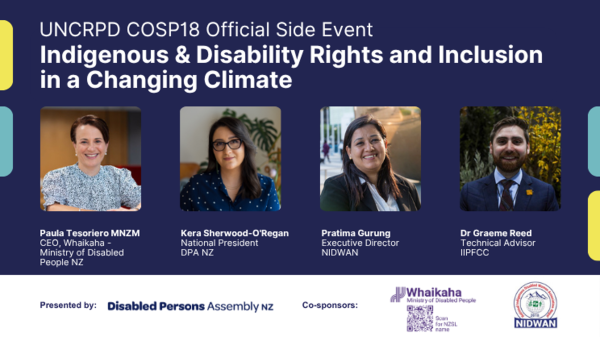 At the 18th session of the United Nations Conference of States Parties (COSP18) to the Convention on the Rights of Persons with Disabilities, DPA NZ hosted a side event bringing disabled and Indigenous leaders to the forefront of global climate discussions.
Chaired by DPA’s National President Kera Sherwood-O’Regan (Kāi Tahu), the session was a strong reminder that rather than asking for a seat at someone else’s table, Indigenous and disabled leaders have long been creating their own spaces for dealing with climate change, with their communities, with care, and with ancestral knowledge. It is time the rest of the world caught up.
In response to questions from participants, a panel of speakers from Nepal, Canada, and Aotearoa New Zealand shared insights and lived expertise on the disproportionate impact of climate change on disabled and Indigenous peoples.
They pointed out that disabled and indigenous people are most affected, but also best placed to plan for their needs in environmental disasters, such as the current forest fires in Canada. Indigenous communities, meanwhile, hold centuries of knowledge about living sustainably and in relationship with the environment. As Kera commented, “We are not Indigenous people over here and disabled people over there — many of us live at those intersections every day.” These communities are not only the most impacted; they are vital to designing climate resilience.
Pratima Gurung, an Indigenous disabled woman from Nepal, highlighted that over 45 million Indigenous disabled people in the Asia-Pacific region alone face poverty, discrimination, and exclusion, especially during climate emergencies. She called out the systemic neglect in emergency planning and international development, urging for meaningful involvement from the start — not just after decisions have been made.
Dr Graeme Reed, an Anishinaabe policy leader from Canada, reminded us that climate change is not just about rising temperatures. It’s rooted in colonialism, ableism, and capitalism. He referenced the First Nations Climate Lens, a framework that centres Indigenous knowledge, natural law, and lived experience to guide more ethical, effective climate responses.
Kera Sherwood-O’Regan brought a powerful intersectional lens to the discussion. She emphasised that many Indigenous people do not necessarily use Western terms like “disabled” to describe chronic illness, neurodivergence, or embodied difference, yet that doesn’t mean those experiences are absent. She challenged dominant systems that silo identities and marginalise Indigenous knowledge, arguing that inclusion must be more than symbolic. “We don’t want to be included in systems that are still harming our people — we want to change the system itself.”
Too often, climate policies, conservation projects, and emergency responses exclude Indigenous and disabled perspectives. Even the global climate movement can be physically and culturally inaccessible. As Graeme said, “International systems are not only extractive — they’re also exhausting.” With long days, inaccessible spaces, and rigid power dynamics, many global forums remain out of reach for those most affected. As Kera noted, “We’re constantly having to fight just to be in the room, and when we are, we’re often expected to leave our cultures and identities at the door.”
Still, change is happening. Indigenous disabled leaders have fought hard to insert disability into UN climate conversations, especially through alliances like the International Indigenous Peoples’ Forum on Climate Change (IIPFCC). Their persistence has opened doors, though more work remains to make these spaces truly inclusive.
The meeting was a call to action. We need to:
- Fund Indigenous-led grassroots organisations directly.
- Design emergency and climate plans that are accessible, culturally relevant, and built with the knowledge of disabled and Indigenous communities.
- Respect diverse worldviews, including how disability is understood and experienced across cultures.
- Shift power away from extractive systems and towards relational, values-based leadership grounded in care, connection, and justice.
Kera, Graeme, and Pratima also honoured many others leading this work, including Ariel Deranger (Indigenous Climate Action), Teaanei Y, Janine Yazzie, and Māori advocates revitalising Indigenous sign language and climate kaupapa across Aotearoa.
In her closing remarks, Miriam Pierard, speaking on behalf of Paula Tesoriero, Chief Executive of Whaikaha – Ministry of Disabled People, acknowledged DPA’s ongoing leadership in highlighting the intersection of disability, Indigeneity, and climate justice.
Miriam stressed the importance of recognising that Māori experience both higher rates of disability and disproportionate climate impacts. This is something that must be reflected in all policy responses. She emphasised that inclusion isn’t about added cost, but about thoughtful, early planning that puts those most affected at the centre.
The kōrero closed with a karakia from Kera, affirming the need for spiritual and relational grounding in climate justice. It was a reminder that this work is not only political, but deeply personal and grounded in whakapapa.
The message was loud and clear: Indigenous disabled people have the knowledge, vision, and leadership needed to tackle the climate crisis — not as an afterthought, but as central architects of the solution. It’s time to back that leadership with real support, genuine partnerships, and the respect it deserves.
DPA is proud to stand with and amplify these voices, and we are committed to continuing this vital work, both here in Aotearoa and on the international stage.
The side event can be viewed “Indigenous and Disability Rights in a Changing Climate”, Facebook.
Patti Poa, DPA Policy Advisor, delivered a shadow report to the United Nations Committee on the Elimination of Discrimination of Women (CEDAW) in September 2024.
In developing the report, the first step was to establish relationships with disabled women, who would inform the content of the report.
In early May 2024, DPA Business Manager Michael Nolan met with the Cook Island National Disability Council (CINDC), taking an opportunity while in the Cook Islands for personal reasons. Discussions at that meeting were about the challenges for the disability community within the Cook Islands, the CINDC strategic plan, emergency preparedness, funding for disability related projects within aid packages, and transport.
Later that month Michael Nolan and Pip Townsend met with the Pacific Disability Forum (PDF) in Auckland to hear about and discuss the PDF’s strategy and action plan. This included identifying ways DPA, as a member of the PDF could be further involved with supporting the overall wellbeing of disabled people in the Pacific. We will be considering how we can strengthen this workstream in 2025.
Find out more about the Pacific Disability Forum.