Events details
Finding Common Ground – a UNCRPD COSP 19 Side Event
- Date: Tuesday 9 June 2026
- Time: 8:45am - 10:00am
- Location: Online via Zoom
- Cost: Free
- Registration: https://events.zoom.us/ev/Akm8T8TLU5KXFXBZvclPPIb31lpi9sa0H1XKIxxWMvgcY0ijaT1v~AivtjsHueQWMAcyM90YKMmrm21idWaUvsMO5gGkJPBH4dj7-7bRhXW0iPQ
Note the event timing for EDT and NZT
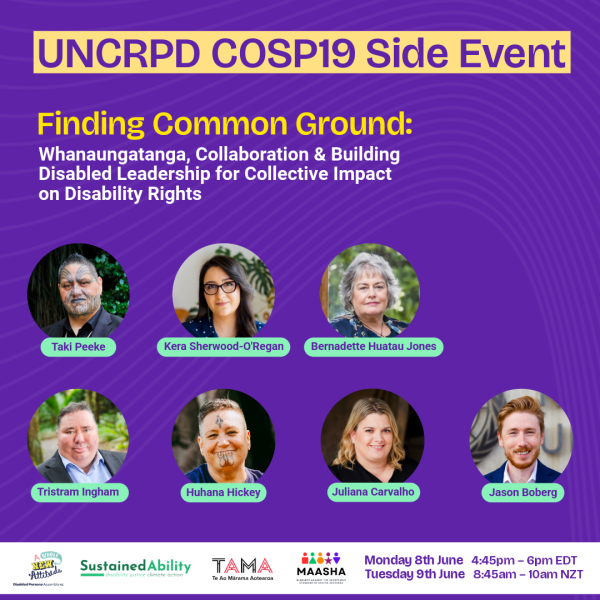
- Monday 8th June 4:45pm – 6pm EDT
- Tuesday 9th June 8:45am – 10am NZT
Primary Sponsor: Disabled Persons Assembly New Zealand Inc (DPA)
Co-Sponsors: Te Ao Mārama Aotearoa (TAMA), SustainedAbility Disability and Climate Network, Migrants Against the Acceptable Standard of Health Aotearoa (MAASHA)
Side Event synopsis
In a changing world where governments are increasingly challenged to uphold human rights commitments and international obligations, disability communities are finding new ways to drive progress from the ground up.
National initiatives like Finding Common Ground; grassroots organising through MAASHA; and efforts to strengthen disability representation within international climate governance, demonstrate how disabled people are using the CRPD and its periodic review process as tools for accountability, advocacy, and collective action.
These initiatives move beyond participation alone, creating pathways for meaningful representation, leadership, and civic engagement, and demonstrate how disabled communities are actively shaping the next phase of CRPD implementation rather than waiting for it to happen.
In this dynamic session, we will hear from disabled leaders who are championing these collaborative, cross-sector, cross-community leadership and advocacy initiatives that are shaping disability rights movements and translating the UNCRPD into practice — from Aotearoa New Zealand to the global arena.
Themes
Overarching COSP19 theme: “CRPD at 20: celebrating and consolidating achievements and shaping the next phase of implementation in a changing world”
Sub-theme 3: “From participation to representation: enhancing accessible civic engagement, leadership and advocacy in political and public life” with a specific focus on collaborative, cross-sector, cross-community leadership and advocacy initiatives that are shaping disability rights movements, and translating the UNCRPD into practice across the Asia Pacific region.
Speakers
Te Ao Mārama Aotearoa Trust (TAMA); Finding Common Ground Steering Committee member
Tristram Ingham (Ngāti Kahungunu ki Heretaunga, Ngāti Porou) is a clinical epidemiologist, public health physician and disability advocate based at the University of Otago, Wellington. He is Chair of Te Ao Mārama Aotearoa Trust (TAMA), the national pan-iwi, pan-impairment Indigenous Disabled Persons Organisation for Aotearoa, and Executive Lead of the Foundation for Equity and Research New Zealand (FERNZ). He is Co-Director of Te Ao Mārama National Māori Health, Wellbeing and Disability Panel, which has produced the largest kaupapa Māori disability dataset ever assembled in Aotearoa.
Tristram has lived with a physical disability since birth, and his work sits at the intersection of clinical epidemiology, kaupapa Māori research, Māori data sovereignty, and human rights. He has held national governance roles including Co-Chair of the Establishment Partnership Group for Whaikaha – Ministry of Disabled People New Zealand, member of the Royal Commission on Abuse in Care Disability Reference Group, and Board Member of Te Tāhū Hauora (the Health Quality and Safety Commission). He served on the Aotearoa Independent Monitoring Mechanism for the UN Convention on the Rights of Persons with Disabilities and presented to the CRPD Committee in 2022.
Tristram is a member of the Finding Common Ground Steering Committee. His scholarship includes Karanga Rua, Karanga Maha and the Multidimensional Impacts of Inequities for Tāngata Whaikaha Māori. He was nationally recognised for leading the COVID-19 “bubble” strategy to protect disabled and immune-compromised communities.
Te Ao Mārama Aotearoa Trust (TAMA); Co-Chair Finding Common Ground Steering Committee
Bernadette Huatau Jones (Ngā Wairiki, Ngāti Apa) is a kaupapa Māori health researcher, registered nurse, and Co-Principal Investigator of Te Ao Mārama National Māori Health, Wellbeing and Disability Panel. She is an Associate Professor in the Department of Medicine at the University of Otago, Wellington, and Co-Director of the Foundation for Equity and Research New Zealand (FERNZ). She brings five decades of clinical and research practice across Aotearoa and Australia, alongside lived experience of disability.
Bernadette's scholarship sits at the intersection of identity, intersectionality, and health equity for tāngata whaikaha Māori. She is lead author of Karanga Rua, Karanga Maha: Māori with lived experience of disability self-determining their own identities, and a co-author of The Multidimensional Impacts of Inequities for Tāngata Whaikaha Māori and Intersectionality and Health Equity. Her work has shaped how Aotearoa understands the paradigmatic misalignment between Global North disability constructs and Māori identity, and has built the empirical case for measuring disability through Te Pae Mahutonga rather than imported diagnostic frames.
Bernadette is the Pou leader for TAMA in Te Whanganui-a-Tara (Wellington), and chairs the national taumata (leadership council) of the 15 regional Pou leaders from across Aotearoa on behalf of TAMA. She is passionate about building high-trust, co-productive research teams that translate indigenous evidence into equity for whānau Māori, and in building tāngata whaikaha Māori leadership capacity.
Disability Rights Lawyer | Legal Scholar | TAMA
Dr Huhana Hickey (Ngāti Tahinga, Tainui) is one of most respected disability rights lawyers and academics in Aotearoa. She holds an LLB, BSocSci, LLM (Distinction), and a PhD in Law and Tikanga Māori from the University of Waikato, where she became the first Māori woman, the second Māori, and the first disabled person to complete a doctorate in law. She lives with multiple sclerosis and writes and advocates from that lived knowledge as well as her legal training.
In 2008, Huhana became the first lawyer at Auckland Disability Law. She is a member of the New Zealand Human Rights Review Tribunal, has served on the board of Housing New Zealand, and is Co-Director of Pukenga Consultancy. She was appointed a Member of the New Zealand Order of Merit in 2015 for services to people with disabilities.
Huhana is the Pou leader for TAMA in Tamaki-Makaurau (Auckland). She brings te ao Māori, the CRPD, UNDRIP, and Aotearoa human rights law into one frame. She is a co-author of The Multidimensional Impacts of Inequities for Tāngata Whaikaha Māori and a long-standing public voice for whānau hauā and tāngata whaikaha Māori. On 1 June 2026 she filed a formal communication with the United Nations Special Rapporteur on the Rights of Persons with Disabilities concerning regressive disability policy in Aotearoa, including the Disability Support Services Bill currently before Parliament. She speaks at COSP19 as a representative of TAMA and the Finding Common Ground initiative.
Migrants Against the Acceptable Standard of Health Aotearoa (MAASHA); Finding Common Ground Steering Committee member
Juliana Carvalho is a Brazilian disability rights advocate. She became paraplegic at 19 and transformed her experience into a mission to drive change. She created and hosted the public television show Make a Difference, directed the award-winning short film If the Eyes Cannot See, the Legs Cannot Feel, and won Marie Claire Brazil’s Best True Story Award.
Her autobiography In My Chair or Yours? has sold more than 30,000 copies in Brazil, and the English edition reached the Top 100 Hot New Releases on Amazon.com.
Since 2012, Juliana has called Aotearoa New Zealand home. Her resilience and courage in challenging the discriminatory immigration system sparked a movement to overturn the “acceptable standard of health” policy. Her petition—backed by over 35,000 signatures—alongside a bold video campaign featuring shark diving and paragliding, drew widespread media attention and helped expose ableist barriers in immigration policy.
Today, as a campaigner, speaker, and strategist, Juliana is a powerful voice in the disability rights movement, bringing lived experience, fearless storytelling, and strategic leadership. Through humour, passion, and radical disability pride, Juliana challenges perspectives and advocates for a more inclusive world.
Founding Coordinator, SustainedAbility Disability and Climate Network
Jason Boberg is a disabled innovator, strategist, and climate expert with over a decade of experience working at the intersection of disability rights and climate.
He is the Founder and Director of Activate Agency, a disability-led social impact agency embedding disability rights across climate, human rights, and innovation, through research, policy, and narrative change. Activate has led major initiatives to increase disability-led climate adaptation.
Boberg has engaged at UN climate negotiations since 2017, co-founded the SustainedAbility Disability and Climate Network (SDCN), creating the groundwork and vision for the effort to establish a Disability Caucus within the UNFCCC.
Jason is also a filmmaker telling ethical stories for change. He co-authored “Nothing About Us Without Us: Climate Change & Disability Justice” in Climate Aotearoa, edited by Helen Clark.
Boberg is a Climate Reality Leader, and has served on the boards of Disabled Persons Assembly (DPA) and the New Zealand Climate Action Network (NZCAN). In 2025 he was a member of the Whaikaha - Ministry of Disabled Peoples working group, refreshing the New Zealand Disability Strategy.
Outside of his advocacy mahi, Jason can be found cycling, adaptive skiing, playing guitar, or behind a film camera.
Te Ao Mārama Aotearoa Trust (TAMA)
Taki will provide cultural guidance and opening the side event.
President, Disabled Persons Assembly NZ; Co-Chair, Finding Common Ground Steering Committee
Kera Sherwood-O'Regan is a proudly disabled and neurodivergent woman from the Kāi Tahu, Kāti Māmoe, and Waitaha people of Te Waipounamu – the South Island of New Zealand. O’Regan is National President of New Zealand’s pan-impairment Disabled Persons Organisation – the Disabled Persons Assembly (DPA) – which represents the voices of disabled members and advocates for systemic change and equity for disabled people in Aotearoa. She represents DPA on the DPO Coalition (Coalition of OPDs), which she is currently chairing. O’Regan represents the DPO Coalition on the Whaikaha – Ministry of Disabled People Strategic Advisory Network, and on the Independent Monitoring Mechanism (IMM) which monitors the New Zealand government’s implementation of the UNCRPD, established under the optional protocol.
As the co-founder of a social impact agency dedicated to Indigenous and Disability rights and climate change, O’Regan’s work centers communities in social change movements – embodying the principle “Nothing About Us Without Us”, drawing on mātauraka Māori (indigenous knowledge and practices), and prioritising the principle of Free Prior and Informed Consent in media and changemaking.
In her spare time, she runs online support for people with Fibromyalgia; advocates for Indigenous and disability rights within the United Nations Climate Change system with the International Indigenous Peoples’ Forum on Climate Change and the SustainedAbility Disability and Climate Network.
Kera is a Climate Reality Leader; Center for Australian Progress Campaigning Fellow; an UNLEASH Innovation Lab 2019 Global Talent on SDG 13 (Climate Change); and was named one of the BBC’s 100 Women of 2023 for her work on Indigenous & Disability rights and Climate Change.
Recent writing includes co-authoring “From threat to opportunity: Climate change and health in Aotearoa” with Dr Rhys Jones, and “Nothing about us without us: Climate change and disability justice” with Jason Boberg - both in Climate Aotearoa, Ed. Helen Clark; and contributing to Children, Citizenship, and Environment by Prof. Bronywn Hayward, and The Intersectional Environmentalist by Leah Thomas.
Related events
Subscribe to our weekly email newsletter!
Information Exchange newsletter is sent out weekly with the latest news and information from DPA and the wider disability sector.
Subscribe